
By Zachary Helton
There’s a value at the heart of progressive religious practice that I deeply value, and that’s the conviction that what a belief or practice does is far more important than what it is.
I remember one of the first times I was confronted with this conviction. I was working with a congregation where many of us (including me) had come from high-control backgrounds—places where it was all about the right beliefs and right practices to make our “whitemalegod” happy. Though we’d moved pretty far away from those worlds, the residual tendrils of orthodoxy-anxiety still showed up now and then, wrapped around our mind in unexpected places. For example: in the way we approached Communion. Though we’d long since let go of the guilt-laden symbols of penal atonement, there still felt like there was a particular way Communion was supposed to be done. A respectable and holy way. A way the bread and wine were to be arranged … the place it was assigned in the liturgy … the words that had been said so many times they felt like they could’ve been written on the tablets of stone at Sinai …
You didn’t mess with Communion.
Until one Sunday, someone did.
It was the first week of June, and several months prior, I remember a community member named Jenna had stepped up to ask if she could start making the Communion bread at home. This was, of course, a welcome change for those of us who had grown up eating Styrofoam wafers. Homemade bread somehow felt “holier” anyway. And things had been going well … until the first Sunday of June rolled around.
That Sunday, everything was placed in its proper position. Jenna’s bread was up there alongside pitcher and chalice. The service had gone predictably—the hymns and homily unfolding according to plan. We were ready to move into the time of Communion. As the pastor stood in the front of the room, reciting those familiar words of institution … as she held the bread before her, breaking it into two … many of us paused to do a double take.
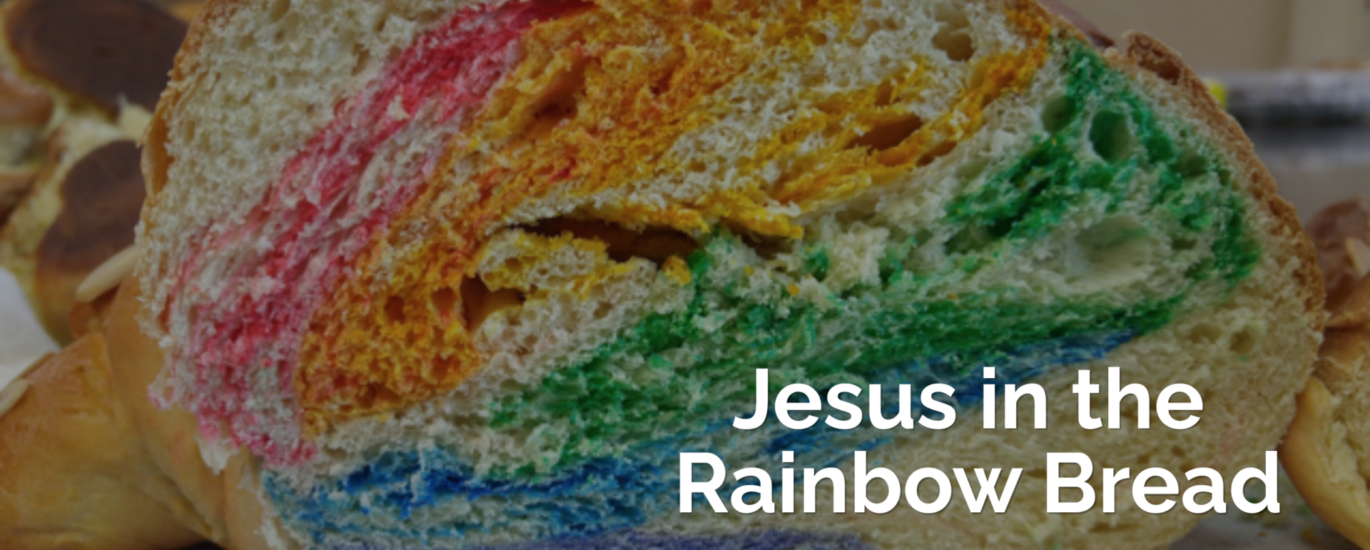
We had expected to see the normal, fresh white bread we’d gotten used to. Instead, there before the altar, running through the inside of the bread, was a bright swirl of color.
A rainbow, running through the Body of Christ.
It was the first Sunday of Pride month, it turned out, and Jenna had taken it upon herself to make a small adjustment.
In that moment, I remember feeling energized in a way that took me off guard. There were plenty who felt otherwise—who crossed their arms and grumbled like Pharisees about how that just wasn’t how we did Communion … but the sight electrified something in my soul. In a moment, it made me reimagine what we were sustaining ourselves on. To see the bread as nourishment for the work of love and justice. As I stood in line to receive the elements, it made me reconsider who Christ stood in solidarity with and invited me to do the same. As I took the bread, it made me rethink just who owned this table and who it was for.
I’ll always be grateful to Jenna for taking that risk, despite the fallout it invited. It was one of the first times I realized that what a belief or practice does was far more important than what it is. That’s something I’ve carried with me into my ministry.
When I plan services now, I hold the value that it’s not about praying the right way but asking who we’re praying for and how that’s connecting and transforming us. When I preach, I hold the value that it’s not about believing in a certain atonement theory but asking how the way we read the story nourishes our spiritual imagination and puts us in solidarity with the most vulnerable. When I sit on committees, I hold the value that it’s not about following a tradition but asking who that tradition may be protecting and what fruit it bears. I think Jesus was a master at this, and I try to follow his lead. So, you’re exchanging money in the Temple? Let’s ask who that might exclude from worship. So, you want to hassle us about ritual hand washing or picking grain on the Sabbath? Let’s ask how you might be hiding behind that to avoid God’s call to love and justice.
This is something I see reflected in the way the Alliance practices partnership and how we encourage our partners, and I’m grateful for it. I’m grateful to be a part of a theological family that stands in a tradition of sacred scandal, risking sacrilege to more fully embody the Spirit of God. I’m grateful to be part of a family that reminds me to be as curious about the function of a belief or practice as I am about its content. Because I’ve found that when we can get curious about that, then we can find the agency to ask the next, more important question:
Is this really helping us embody the world we want to see?
***
Zachary Helton is an author, board-certified spiritual care counselor, and pastor serving Glendale Baptist Church in Nashville, Tennessee. Ordained through the Alliance, he is passionate about helping people cultivate a faith that is emotionally healthy, intellectually honest, and rooted in compassion. He is the author of the historical novel Metta Valley Gospel, which reimagines the life of Jesus through the lenses of interfaith spiritual formation, religious trauma, and liberation.
Recent Comments