
by Malkhaz Songulashvili
On 24 May 2026, the Peace Cathedral in Tbilisi witnessed a remarkable and deeply symbolic event: the consecration of the Jalaleddin Mevlana Rumi Ambo, a stone liturgical pulpit dedicated to the memory of the thirteenth-century Muslim mystic, poet, and teacher of love and unity, Jalaleddin Mevlana Rumi.
For nearly 160 years, the Peace Cathedral has embodied a distinctive Protestant-Baptist Orthodox expression of Christianity across the Caucasus and beyond. Throughout its history, often marked by marginalisation and hostility, the Cathedral has responded not with bitterness but with a theology of beauty. Wherever political, cultural, social, or religious ugliness has appeared, it has sought to answer with acts of creativity, reconciliation, and hope.
This commitment is visible throughout the Cathedral complex. Beneath its roof are a Peace Mosque, a Peace Synagogue, a Buddhist Peace Shrine, and an Oratory of Reconciliation— spaces welcoming people of all faiths and none. Together they reflect both Georgia’s historic traditions of hospitality and the Cathedral’s vocation as a house of peace.
Over many years, the Cathedral has cultivated friendships with faith communities across the Middle East. Among its closest partners is the Mevlevi Sufi Order, represented by the Venerable Sheikha Nur and spiritual descendants of Hazrat Mevlana Rumi. Rumi (1207– 1273), whose life was centred in Konya in present-day Türkiye, remains one of the most beloved spiritual figures in history. His writings, especially the Masnavi and the Diwan-e Shams, speak of divine love, human unity, and the transformative power of compassion. His teachings gave rise to the Mevlevi Order, often known in the West as the Whirling Dervishes. The inspiration for the new ambo emerged during a visit by a Peace Cathedral delegation to Istanbul in December 2018. Encountering an early Christian stone ambo in the shadow of Hagia Sophia inspired the Cathedral’s architect, the Rev’d Giorgi Songulashvili, to design a liturgical pulpit that would honour Rumi’s legacy while serving as a permanent symbol of interreligious friendship. Although completed during the Covid-19 pandemic, its consecration was intentionally delayed until representatives of the Mevlevi tradition could be present.
The service brought together representatives of Jewish, Christian, Muslim, Yazidi, and non affiliated communities in a visible expression of mutual respect and solidarity. Opening the ceremony, the Cathedral Leader welcomed the assembled guests and reflected on the purpose of the new ambo:
“May the words spoken here bind the wounds of our world, enlarge compassion and draw strangers into neighbourliness. Let the voice that rises from this place be like a lamp, seeking only to give light.”
The congregation responded repeatedly with prayers for peace and healing, affirming together: “We choose healing.”
A central Peace Candle was lit and shared among representatives of the participating traditions. As the flame passed from one candle to another, the congregation proclaimed:
“May this light kindle peace.”
Sacred readings followed from each represented tradition. A reading from the Hebrew prophet Micah called worshippers to “do justice, love kindness and walk humbly with God.” A passage from the Gospel of John proclaimed Christ’s gift of peace. A reading from the Qur’an emphasised the dignity of all peoples and the divine purpose of human diversity. Representatives of the Yazidi community shared a traditional text celebrating concord and unity.

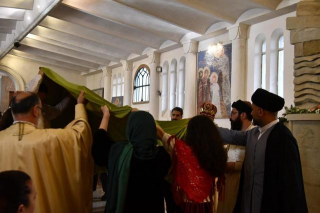

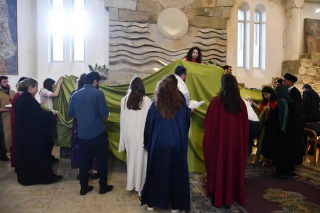
The culmination of the readings came from the Mevlevi tradition itself. A passage from Rumi’s Dîvân-ı Kebîr was proclaimed, in Original Persian (Yashar Ajami) and Georegian (Lasha Mdzevluri), calling humanity to recognise its essential unity:
“We, all the human beings, are in reality all one essence. Our minds are one, and our heads are one.”


The ceremony then moved to a rite of blessing involving water, the laying on of hands, and prayer. Representatives of each community approached the ambo, placed a hand upon it, and offered prayers according to their traditions. Jewish, Christian, Muslim, Yazidi, and secular representatives invoked healing, wisdom, justice, peace, and reconciliation for all who would speak from the newly consecrated pulpit, which will serve as a principal voice of the Peace Cathedral.
Together the assembly prayed:
“May this place be cleansed and set apart for truth, care, justice, reconciliation, peace and freedom.”



A sermon (khutba) was then delivered from the newly consecrated ambo by Fatime Bahar Can, a spiritual successor of Mevlana Rumi. Her words marked the first proclamation from the Rumi Ambo and formed the central act of its dedication. She was accompanied by
distinguished members of the Mevlevi tradition, including Sufi dervishes Selçuk Cemoğlu and Tülin Özgür, long-standing friends of the Cathedral. The sermon was translated by Bishop Ilia Osepashvili.
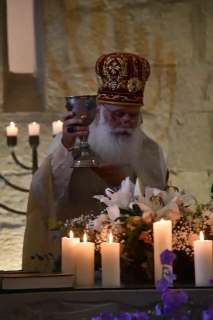
The service continued with the celebration of the Christian Eucharist, affirming the Cathedral’s identity as a Christian house of worship while demonstrating that Christian faith need not fear friendship, hospitality, or dialogue. Greetings were also offered by Dr Anna Maria Schneider of the Embassy of Germany in Georgia.
The concluding section featured brief benedictions from leaders representing the Sufi, Shia Muslim, Sunni Muslim, Yazidi, Jewish, and Christian communities. Their presence together around the newly dedicated ambo testified to relationships cultivated over many decades and to a shared commitment to peace in a fractured world.

Following the final blessing, the congregation departed to instrumental music and a time of fellowship and refreshments.
The consecration of the Jalaleddin Mevlana Rumi Ambo stands as a singular event in contemporary religious life. It is rare for a Christian cathedral to dedicate one of its principal liturgical furnishings in honour of a Muslim mystic. Yet the gesture was not intended to dilute religious identity, but rather to affirm that authentic faith can recognise and celebrate wisdom, beauty, and holiness wherever they are found.
In an age often marked by conflict, suspicion, and division, the Rumi Ambo offers a different vision. It stands as a permanent invitation to speak words that heal rather than wound, to build bridges rather than walls, and to remember, with Rumi, that beneath our many languages, traditions, and histories, humanity shares a common dignity and a common longing for peace.
As a symbol of interreligious friendship and reconciliation, the Rumi Ambo now takes its place within the life of the Peace Cathedral—a stone witness to the possibility of unity amid diversity, and a lamp whose purpose is simply to give light.



Recent Comments