
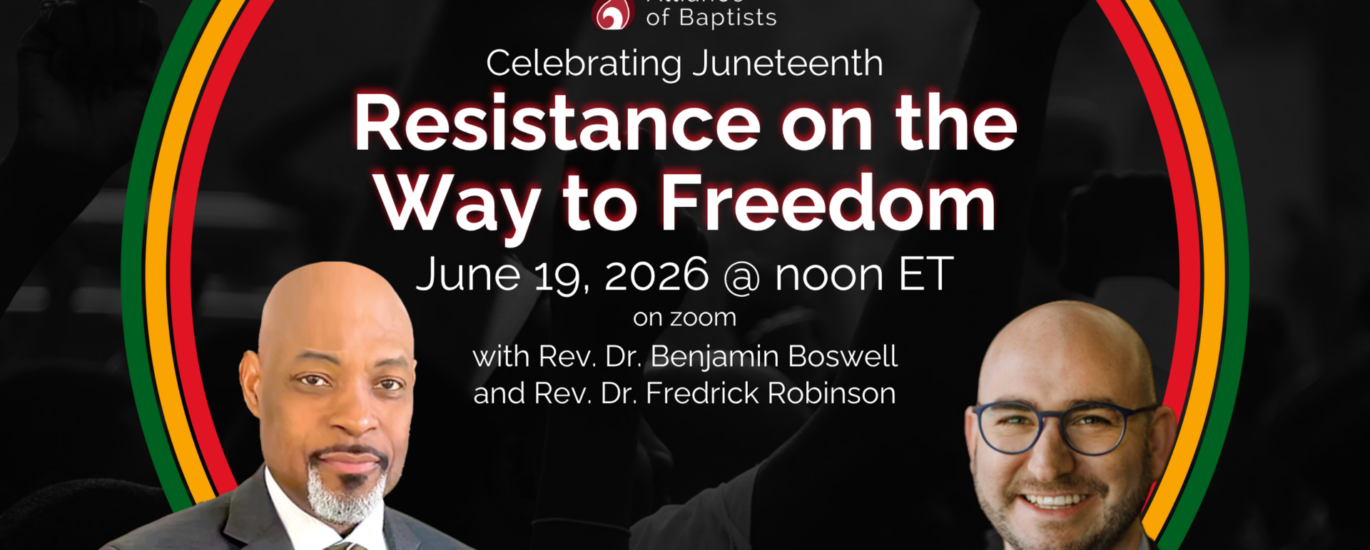
by Reverend Dr. Fredrick Robinson
PLEASE NOTE: We invite you to join Rev. Dr. Robinson and Rev. Dr. Benjamin Boswell today (June 19, 2026) for “Resistance on the Way to Freedom“, a special Juneteenth event on 12:00PM Eastern on Zoom. Register here!
In light of today’s political environment, where Black people are being forced to refight battles won long ago, this Juneteenth hits differently. We are living in a Jeremiah kind of moment, where leaders are quick to say “peace, peace” while the wounds of God’s people are still open and bleeding. Indeed, the moment we are living in reminds us that for Black people in this country, it is always something. Freedom is announced, then delayed. Progress is won, then resisted. Every step forward is met with a counter-move designed to drag us backward. And that train is never late.
That was certainly true in Texas, where enslaved people did not learn they were free until June 19, 1865, more than two years after the Emancipation Proclamation. Juneteenth marks not only delayed freedom, but delayed truth. It reminds us that emancipation on paper is not the same as emancipation in life. And that gap between promise and reality has defined much of Black history in America.
After Reconstruction, when Black political power briefly flourished, white supremacist terror rose to crush it. The Ku Klux Klan emerged as part of that backlash, and the era of lynching, disenfranchisement, and Jim Crow soon followed.
That pattern continued into the twentieth century. Following the Supreme Court’s decision in Brown v. Board of Education, there was a massive resistance campaign by white politicians and communities, including the closing of public schools and the diversion of public funds into private educational coffers.
The civil rights movement won landmark victories, but not without the usual backlash. “Law and order” rhetoric, coded appeals to “states’ rights,” and the Southern Strategy all worked to preserve white power while speaking in supposedly race-neutral language. Black liberation was treated as a threat to social order and met with structural resistance, including gerrymandering, voter suppression, and drug policies that contributed to the rise of mass incarceration.
Then came the election of Barack Obama, and with it another wave of white backlash. For some, his presidency symbolized progress and possibility but for many whites, it triggered anxiety, resentment, and open racial hostility. The Tea Party rose in that atmosphere, presenting itself as a movement about taxes and constitutional originalism, but was really about racial grievance and political obstruction. What appeared on the surface as populist outrage was actually a reaction to a changing America, the browning of the electorate, the growing visibility of Black leadership, and the idea that the country might be slipping from white male hands. That backlash crystalized into the shameful and grotesque politics of Trumpism and MAGA, which made explicit what had long been coded: fear of demographic change, nostalgia for racial hierarchy, and contempt for a multiracial democracy.
This is where we are politically now. We are living in a moment of active rollback. Diversity, equity, and inclusion have been reframed as threats, as if naming inequality were itself the problem rather than the inequality. Voting rights are under attack through new waves of voter ID laws, voter roll purges, reduced polling access, and a racist redrawing of voting districts all of which has been accelerated by the Supreme Court’s recent decision to gut Section 2 of the Voting Rights Act. The result is a politics of reversal: not simply opposition to progress, but a determined effort to make the country safer for white male hierarchy and less accountable to truth.
So maybe this Juneteenth is a time to fully realize that these are not disconnected events but chapters in the same recurring story. America has a baked-in tendency to resist Black advancement, and when Black people gain ground, the resistance often comes dressed as order, tradition, or common sense.
That is why Juneteenth matters so much. It is not only a celebration of freedom delayed. It is a summons to remember that freedom in this country has never been automatic, and never permanent without struggle. It asks us to be honest about the structure of backlash and disciplined enough to resist it. We need strategy, not just symbolism. We need institutions that can endure pressure. We need organizers, voters, teachers, clergy, lawyers, artists, and neighbors who understand that protecting hard-won gains is part of the work of liberation. As Maya Angelou said, “History, despite its wrenching pain, cannot be unlived, but if faced with courage, need not be lived again.”
So this Juneteenth, may we collectively reject the temptation—particularly our white allies—to declare “peace” too quickly. Instead, may our preaching, our praying, and our public witness bear honest testimony to the wound and to the God who refuses to leave us in bondage. And as we do, may the Lord who spoke through Jeremiah give us the courage to tell the truth, the humility to repent, and the holy imagination to work for the kind of peace that actually looks like justice, feels like freedom, and sounds like good news to the wounded people of God.

Rev. Dr. Fredrick Robinson is the Senior Pastor of Mt. Gilead Missionary Baptist Church in Atlanta, GA. He is a social justice advocate and the author of Advent in the Time of Fascism: Remembering, Resisting and Rebirthing God’s Possibility in the World.

Recent Comments