
By the leadership of the Justice for Palestine and Israel (JPI) Community.
This letter was originally shared through the JPI Community newsletter on October 16, 2025. If you’re interested in keeping up with what is happening with the JPI Community, sign up for their newsletter. To request to be added to our list, email AllianceJPI@gmail.com.
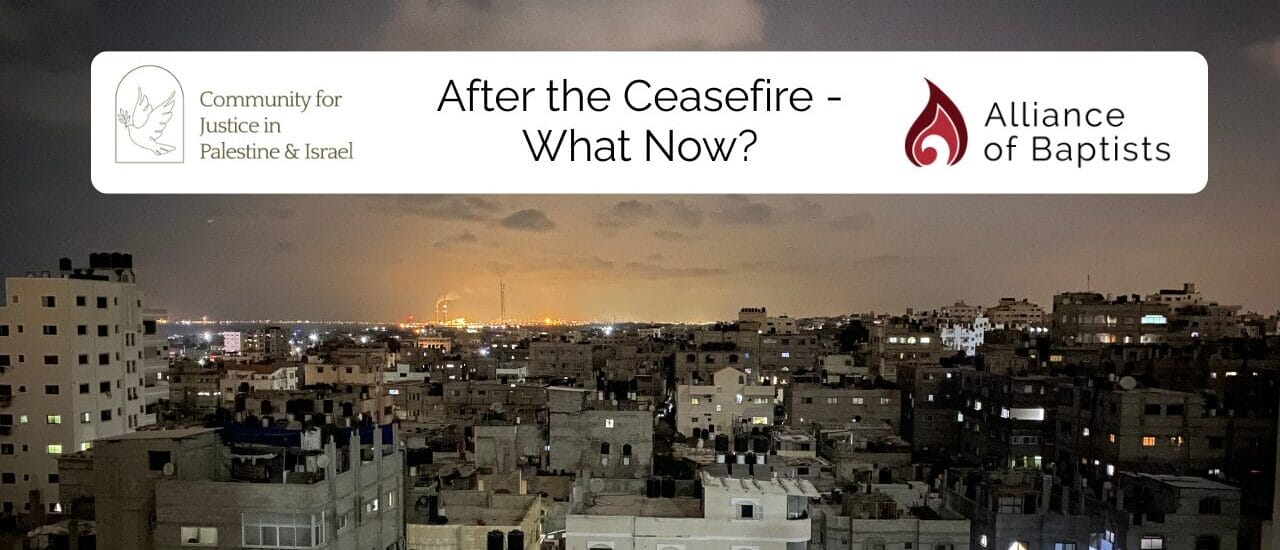
The leadership team for the Alliance Community for Peace in Palestine and Israel met a few days after a fragile ceasefire was declared in Gaza. Like you, we were conflicted about where we go from here. Here are some thoughts from leadership team members G. J. Tarazi and Leslie Withers.
1. Supposedly, no bombs are falling on Gaza and humanitarian aid has begun to flow into the devastated strip. However, the Israeli military has killed hundreds of Gazans since the alleged ceasefire, and the trickle of aid is far less than needed. The U.S. has ceased providing any food or desperately needed medical supplies. And history reminds us that Netanyahu has broken every treaty he ever signed.
Keep relentless pressure on your elected officials. Demand that our country provide humanitarian aid and hold Netanyahu accountable to keep up Israel’s end of the bargain.
2. G. J. Tarazi, a Palestinian-American member of the JPI leadership team, told us that he has been unable to contact his relatives in Gaza for the past five weeks and that Saint Porphyrius Church, the oldest continuing Christian church in Gaza, to which his family has belonged for seven generations, has been bombed again.
We must insist that Israeli officials be held accountable for criminal acts of genocide, including the widespread killing of civilians and the destruction of Gaza’s homes, churches, schools, and hospitals.
3. The cease-fire does not include the occupied territories in the West Bank, where Israel is extending settlements and barricades to travel, and settlers continue to kill and maim Palestinians, uproot centuries-old olive trees, and prevent the native population from reaching their orchards and grazing lands.
Israel is an apartheid state, and the Apartheid-Free Communities network, of which the Alliance is a member, is more important than ever.
4. U.S. media are aiding the Israeli propaganda campaign by referring to “Israeli hostages” and “Palestinian prisoners,” calling one-sided acts of genocide a “war” and drawing a false parallel between the terrible Hamas attack of October 7 and the subsequent two-year campaign to exterminate Palestinians in Gaza.
We must continue to pray and to educate our congregations and communities about the realities of Israel’s decades of war crimes and illegal occupation of Palestinian land. We must advocate for the things that will lead to a true and long-lasting peace in which all residents of this troubled land have equal rights and opportunities.
5. Take Action: This mass movement of Christians, alongside persons of all faiths and none, exposes complicit corporations and exercises economic power through boycotts and divestment from companies that profit from apartheid, dispossession, and genocide. This economic resistance campaign targets two companies complicit in the ethnic cleansing in Palestine: Palantir and Chevron. National endorsers include Christians and others across the spectrum of traditions.
We call on Chevron and Palantir to stop all contracts with the Israeli government and the Israeli fossil gas industry.
We seek to leverage corporate influence on U.S. and Israeli political leaders for robust humanitarian aid and a permanent ceasefire on the way to a just peace.
Additional Resources from JPI
JPI keeps a list of resources available and will gladly share them with you. Email Mark Reeves for the full list.
Palestinian voices to read and follow:
Jonathan Kuttab is a co-founder of the Palestinian human rights group Al-Haq and co-founder of Nonviolence International. A well-known international human rights attorney, he practices law in the US, Palestine and Israel. A Christian pacifist, he serves on the Board of Bethlehem Bible College and is President of the Board of Holy Land Trust. His website is https://jonathankuttab.org. Among his many publications are:
- Beyond the Two-State Solution, a short introduction to the ongoing crisis in the Palestinian-Israeli conflict. Pointing to the century-long battle between Palestinian nationalism and Zionism, he explains why the two-state solution is no longer a viable option. He formulates a way forward for a 1-state solution that challenges both Zionism and Palestinian Nationalism. Available in paperback.
- The Truth Shall Set You Free. In this moving, harrowing memoir, he takes us on a personal journey from anger and thoughts of violence to his deep commitment to unrelenting peaceful activism. If you want to be inspired and informed. If you want to look past the rhetoric of opposing sides. If you want to witness the fact that there are still good people in this world working for justice, equality, and peace in the face of violence, this book will inform and inspire you.
Rev. Dr. Mitiri Raheb is a Palestinian Christian, the pastor of the Evangelical Lutheran Christmas Church in Bethlehem, the founder and Director of Dar al-Kalima University in Bethlehem. See his website at https://www.mitriraheb.org. He is the author and editor of more than 50 books including:
- Decolonizing Palestine: The Land, The People, The Bible, which challenges the weaponization of biblical texts to support the current settler-colonial state of Israel. Raheb argues that some of the most important theological concepts –Israel, the land, election, and chosen people – must be decolonized in a paradigm shift in Christian theological thinking about Palestine.
- The Politics of Persecution: Middle Eastern Christians in an Age of Empire. Persecution of Christians in the Middle East since the middle of the nineteenth century has experienced a resurgence in the last few years, especially during the Trump era. Middle Eastern Christians are often portrayed as a homogeneous, helpless group ever at the mercy of their Muslim enemies, a situation that only Western powers can remedy. The Politics of Persecution revisits this narrative with a critical eye.
For more helpful background for educational work in Christian congregations:
- In the Eye of the Storm: Middle Eastern Christians in the Twenty-First Century tells the story of the plight of twenty-first-century Middle Eastern Christians in five countries (Palestine, Israel, Jordan, Lebanon, and Egypt) in the context of the so-called Arab Spring.
- Surviving Jewel: The Enduring Story of Christianity in the Middle East. The Christian church was born in the Middle East and grew there for centuries, surviving at great peril within a difficult, even sometimes hostile, political and religious climate. The story of Christianity over the last 1,300 years is not solely one of conflict, marginalization, and persecution but is also about accommodation, interchange, and cooperation.
More Palestinian voices:
- Rashid Ismail Khalidi is a Palestinian-American historian of the Middle East and the Edward Said Professor Emeritus of Modern Arab Studies at Columbia University.[2][3] He served as editor of the Journal of Palestine Studies from 2002 until 2020, when he became co-editor with Sherene Seikaly and has written several books, ncluding The Hundred Years’ War on Palestine a and Palestinian Identity: The Construction of Modern National Consciousness.
- Zeina Azzam is a Palestinian American poet, writer, editor, and community activist who serves as poetry editor for We Are Not Numbers. Her poems appear in over fifty literary journals, webzines, edited volumes, and anthologies. Her full-length poetry collections include Some Things Never Leave You and Bayna Bayna, In-Between. https://www.zeinaazzam.com/
- Mahmoud Darwish was a Palestinian poet and author who was regarded as Palestine’s national poet. In 1988 Darwish wrote the Palestinian Declaration of Independence, which was the formal declaration for the creation of a State of Palestine.
- Fadwa Tuqan was a Palestinian poet known for her representations of resistance to Israeli occupation in contemporary Arab poetry. She has sometimes been referred to as the “Poet of Palestine.”
For more news and analysis not covered by mainstream media:
- Al Jazeera – https://www.aljazeera.com — an independent news organization funded in part by the Qatari government. Al Jazeera has pioneered a new paradigm for in-depth journalism that is relevant to its audience, giving them a broad and deep perspective on regional and international affairs and putting the human being directly at the center of the news agenda.
- Amnesty International promotes the upholding of economic, social and cultural rights, sometimes referred to as “ESC rights,” protected under the Universal Declaration of Human Rights and many human rights treaties. www.amnestyinternational.org
Ways to provide financial support for Palestinians:
- American Near East Refugee Aid is an American 501 non-governmental organization that provides humanitarian and development aid to the Middle East, specifically the West Bank, the Gaza Strip, Lebanon and Jordan. www.anera.org
- Medical Aid for Palestinians is a British charity that offers medical services in the West Bank, Gaza and Lebanon, and advocates for Palestinians’ rights to health and dignity. https://www.map.org.uk
- Unicef, the international organization for children: https://www.unicefusa.org
- United Palestinian Appeal: www.upaconnect.org
Articles:
- Israel and the Palestinians: History of the conflict explained
- Israel and the Occupied Palestinian Territory
- Beyond apartheid and genocide: A broader framework for understanding the Israeli-Palestinian conflict
- Expert Commentary, the Israeli-Palestinian Conflict, and the Question of Genocide: Pro-Semitic Bias within a Scholarly Community?
- The Israeli–Palestinian Conflict

Recent Comments